Project 01 · Web app, live
Slip
A one-line journal that gives your own words back to you as a weekly receipt. No scores, no streaks.
- Context
- Self-initiated · slip-book.com ↗
- Period
- Oct 2026 – now · first public version Oct 8
- Team
- Solo
- Built with
- One HTML file, Vercel serverless functions, OpenAI gpt-4o-mini, Supabase for optional accounts
01 Problem
My paper journal had become too thick to carry everywhere, so I wanted to keep writing in a browser on my laptop.
Persona
The lazy perfectionist
Wants to journal properly: a full page, neat, every day. When there is no time to do it properly, does nothing, and a missed day turns into a missed week. The laziness is on the surface; underneath is a bar set too high to start.
Research separates perfectionistic strivings from perfectionistic concerns (fear of mistakes, of falling short); it is the concerns that go with procrastination (Sirois, Molnar & Hirsch, 2017).
Slip is built for this person. I wanted the smallest possible daily reflection that still gives something back, without turning feelings into a score.
02 Insight
For a lazy perfectionist, “done properly” has to fit in ten seconds, and what comes back has to be their own words, not a grade.
Cost
One line is enough to keep a day. Longer formats should be there for days when there is time, not required, and a missed day is never marked.
Return
A summary that judges you (“your mood score is 62”) is easy to make and easy to resent. Reflecting back what you wrote, in your words, asks nothing of you.
Trust
Numbers on the receipt must be counted, not generated. Language models are unreliable at counting, so the model only labels each note and the browser does the arithmetic.
Evidence
Slip started as a way to keep a gratitude journal going. Writing down what you are grateful for has been studied since Emmons & McCullough (2003); the 3·3·3 page adapts the widely used Five Minute Journal format.
03 Strategy
Notes as pieces of paper, and a weekly receipt as the only reward.
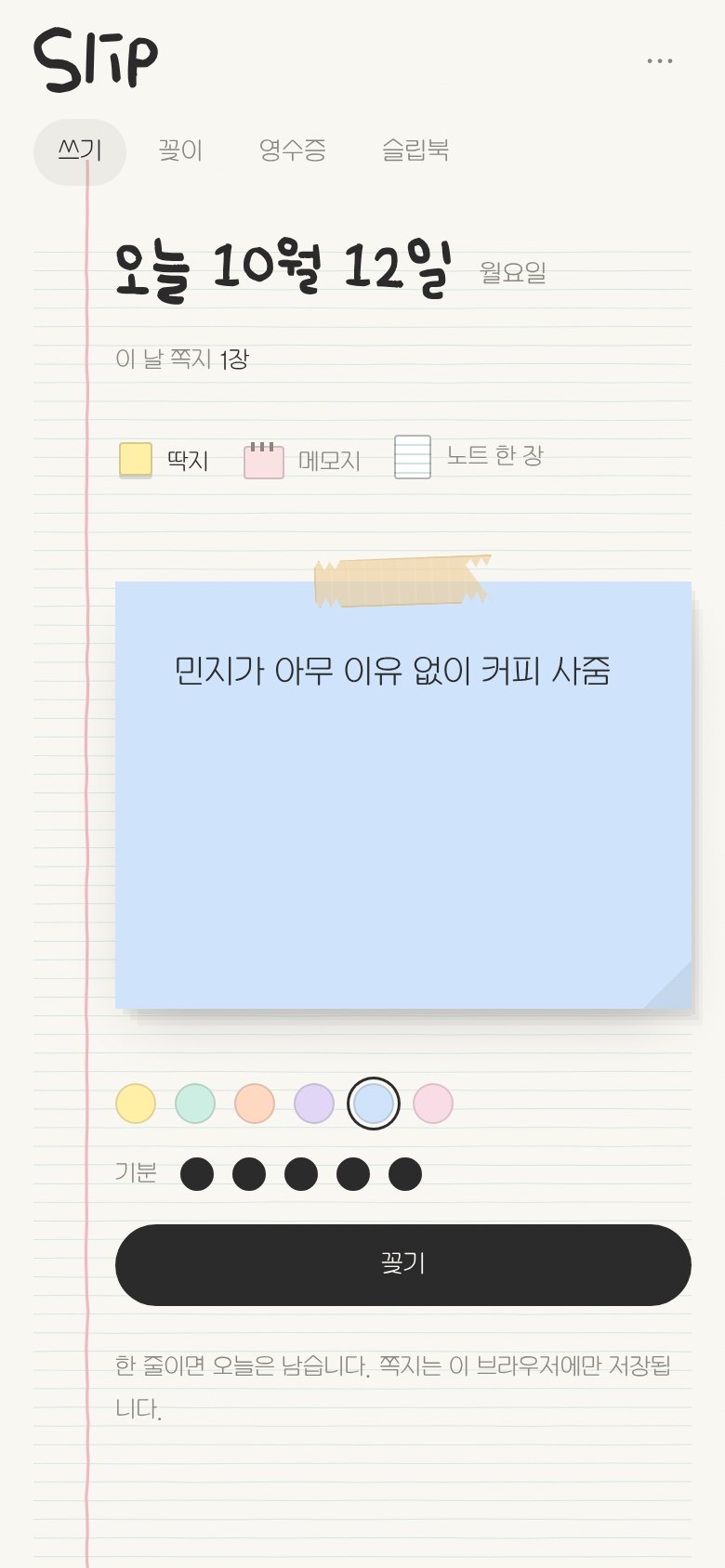
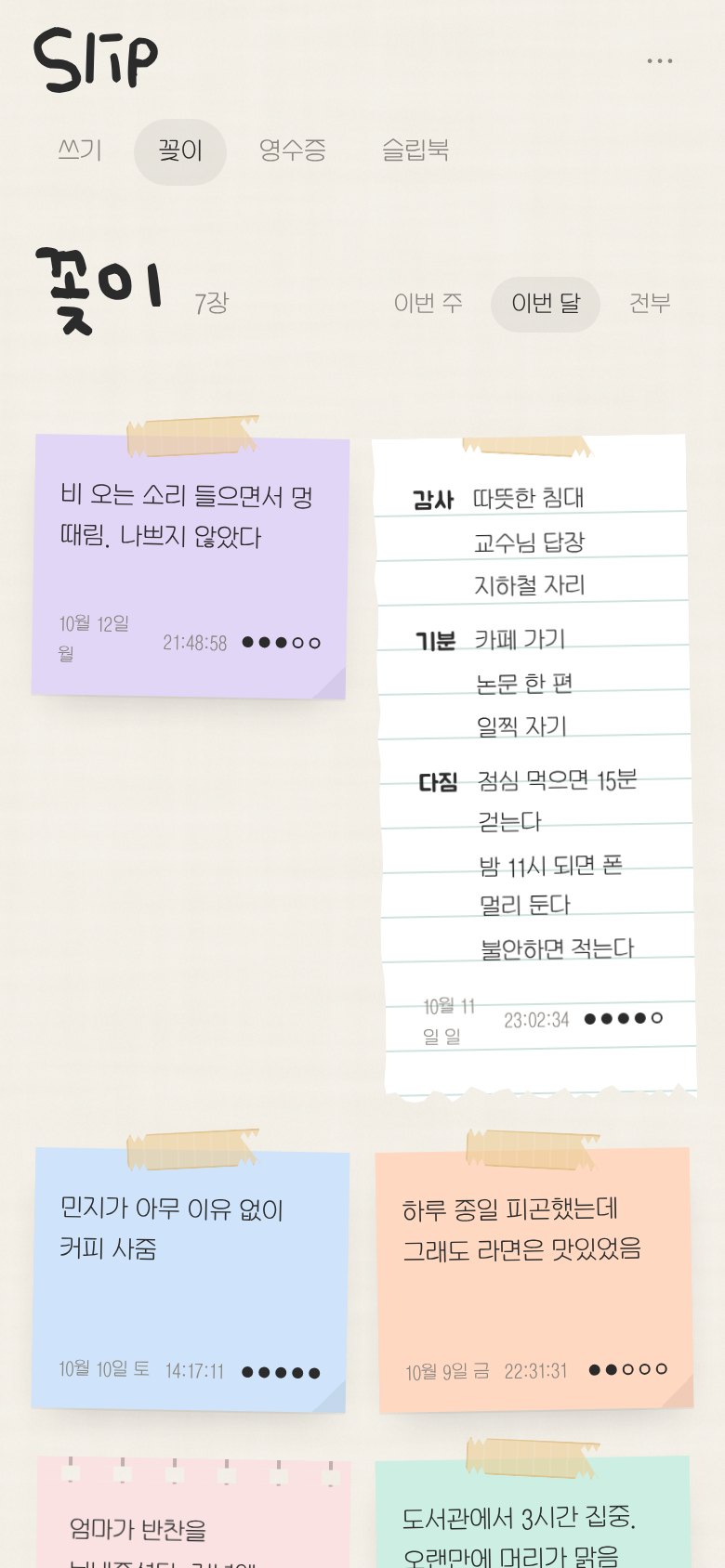
- Three paper types. A one-line slip (about ten seconds), a free memo for longer thoughts, and a 3·3·3 page: three things I'm grateful for, three that would make today good, three intentions.
- Mood is optional. One tap on five circles, or skip it.
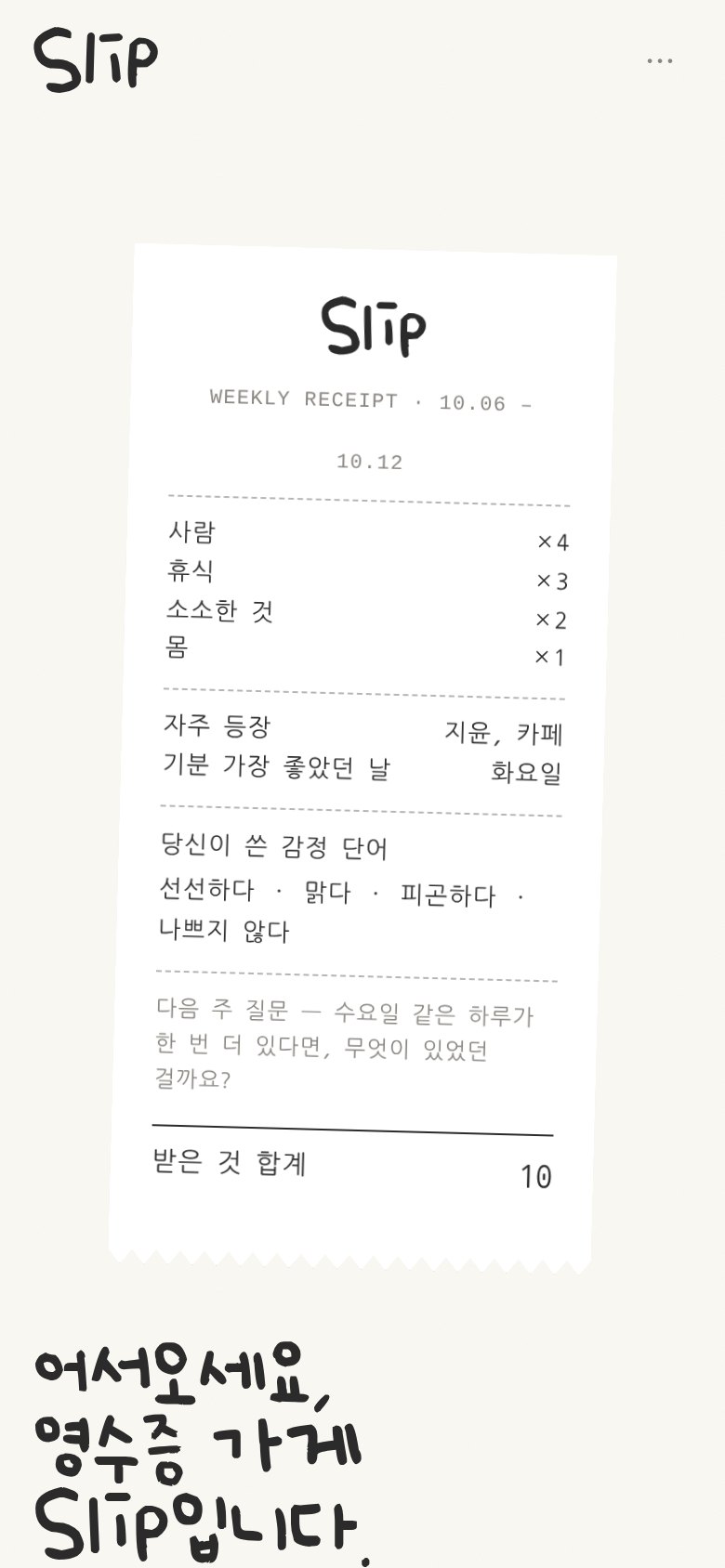
- A receipt, not a report. Once a week has at least three notes, Slip prints a receipt: categories and counts, people and places that kept coming up, the best-mood day, the emotion words you used, and one question for next week.
- Rules for the model. Observe only. No scores, no diagnosis, no advice, and no comparing people (phrases like “besides” and “only” were added to the banned list on Oct 9).
- Privacy by default. Without an account, notes stay in the browser; an optional account (added after launch) keeps them across devices. The week's text goes to the model only when a receipt is made, with no name or email.
04 Execution
Built and shipped in about a week, then changed by the first users.
- WriteChoose a paper and a color, write, ⌘+Enter
- SpikeNotes pile up as torn slips and memos, by week or month
- ReceiptModel tags the week; the browser counts and prints
- KeepSave the receipt as an image; past receipts by month
The server function limits each visitor to 20 receipts a day and 12,000 characters per request.
05 Result
A live app anyone can use, at slip-book.com.
The next feature, a monthly “slip book” that gathers a month of receipts, is announced in the app with an “I'm interested” button, so I can see whether people want it before I build it.
06 Learnings
The decisions that mattered most were about what the AI is not allowed to do.
The model labels notes but never counts them, and it follows explicit rules on tone: observe, don't score, don't compare people. Keeping its job narrow is what lets the receipt be trusted. Shipping early also mattered: the first real feedback changed the product within two days.
07 Where it leads
Slip is an everyday version of my research question.
Does seeing the words you used for your feelings, gathered over a week, change how precisely you describe them the next week? Next I'm running a two-week beta with 5–8 friends, followed by interviews, and comparing how varied their emotion words are in week one and week two. It is a small, honest first test, and it is the kind of study I want to learn to design properly in graduate school.